
Darwin Carbon · Space & Extreme Environments
One material. Multiple mission-critical functions.
Darwin Carbon develops a continuous carbon microfiber platform — Darwin Sheet, Tape and Yarn — combining structural, electrical and thermal functionality in extraordinarily lightweight, flexible forms. It is an enabling material for lighter, simpler, more resilient spacecraft, launch systems, lunar infrastructure and defense platforms — not another space company.
The underlying argument
Space rewards multifunctionality.
When every gram, interface, layer and failure mode matters, a material capable of performing several useful roles becomes disproportionately valuable.
Space didn't start yesterday
Space heritage in the material's lineage
The material technology underlying today’s Darwin platform carries genuine aerospace and space lineage. We state that lineage precisely — heritage that precedes Darwin Carbon is described as lineage, never as a current Darwin contract.
- 01
Material technology
HeritageThe foundational continuous carbon microfiber material technology from which today’s Darwin platform descends.
- 02
Early space / satellite work
HeritagePrior-generation material technology was evaluated and/or used in satellite-related applications.
- 03
NASA Juno lineage
HeritageMaterial technology in Darwin’s lineage was associated with NASA’s Juno spacecraft program. This heritage precedes Darwin Carbon and is not a Darwin-delivered contract.
- 04
Darwin Carbon
DevelopmentDarwin advances that lineage into a multifunctional material platform with modern, scalable manufacturing intent.
- 05
Current space evaluations
Active EvaluationActive and pending technical evaluations with aerospace and communications partners.
- 06
Lunar / next-generation systems
PlannedA planned year-end 2026 NASA BAA submission and forward-looking lunar-surface material concepts.
Why the material fits space
Three fundamental functions. An unusual combination of attributes.
Be precise about functions versus attributes. Darwin delivers three fundamental functions; everything else is an attribute or a system-level benefit — not another function.
Structural
Lightweight load paths, reinforcement and continuous carbon microfiber composite structures with high specific performance.
Electrical
Electrical conductivity for EMI shielding, grounding, ESD control and integrated conductive pathways.
Thermal
Thermal transport and resistive heating — the material can move heat or become the heater itself.
The attributes behind the functions
Three fundamental functions.
An unusual combination of attributes.
Many possible system-level benefits.
- Extremely lightweight
- Thin
- Flexible
- Formable
- Electrically conductive
- Thermally conductive
- Corrosion / oxidation resistant where applicable
- Extreme-environment potential where technically supportable
- Near-zero / negative CTE where applicable
- Consolidates functional layers in some applications
EMI shielding · satellites & spacecraft
Shield the electronics, not the payload budget.
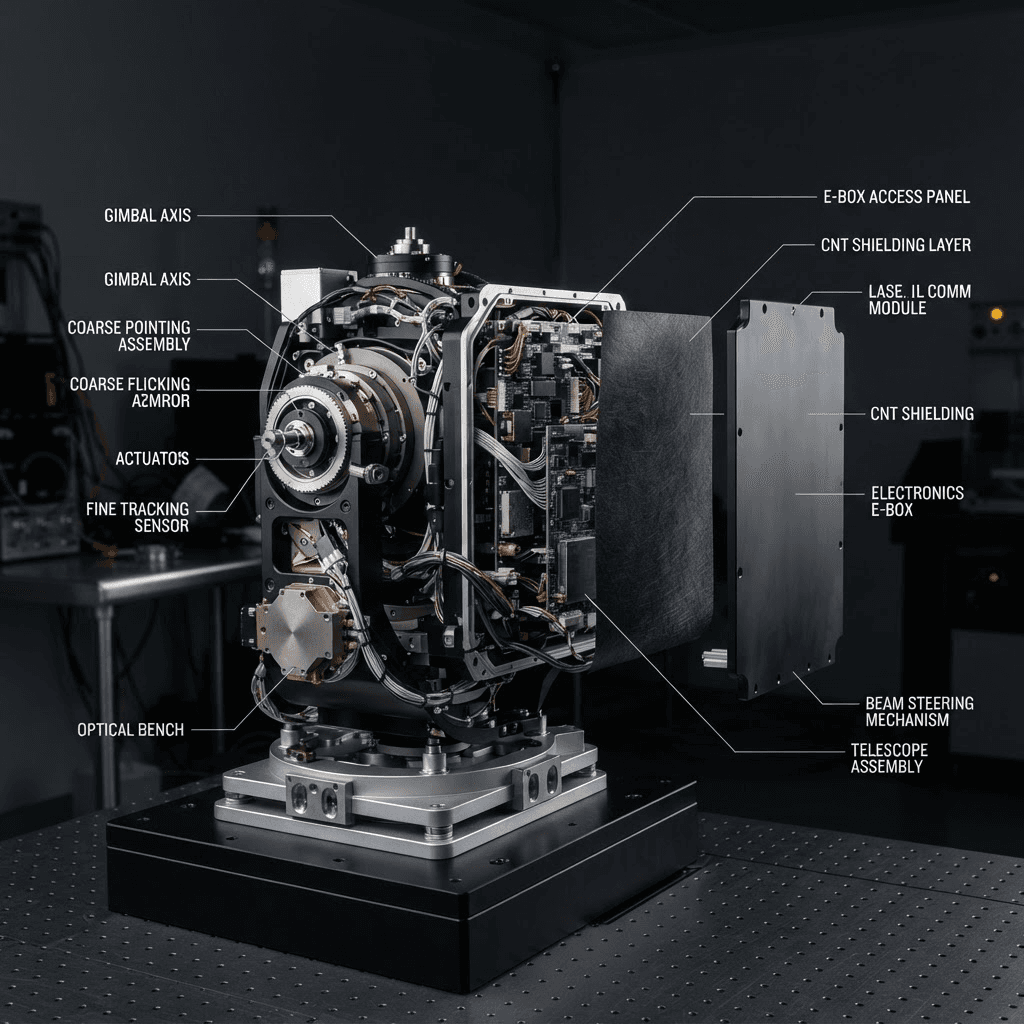
Conventional EMI solutions can impose mass, packaging, integration and geometric penalties. Darwin Sheet is an extremely lightweight, thin and conformable conductive shielding material. Where shielding performance is discussed, it depends on configuration, frequency and integration.
Current / pending industry work
Honeywell Aerospace
Active EvaluationTechnical evaluation work involving EMI shielding for satellite applications. This is evaluation activity — not production qualification, purchase orders or adoption.
Mynaric
Pending EvaluationPending evaluation work involving Darwin material for EMI-related structures associated with laser communications terminals.
Shielding performance depends on configuration, frequency and integration. No production qualification, purchase orders or adoption are implied.
Lunar systems
Materials for the lunar surface
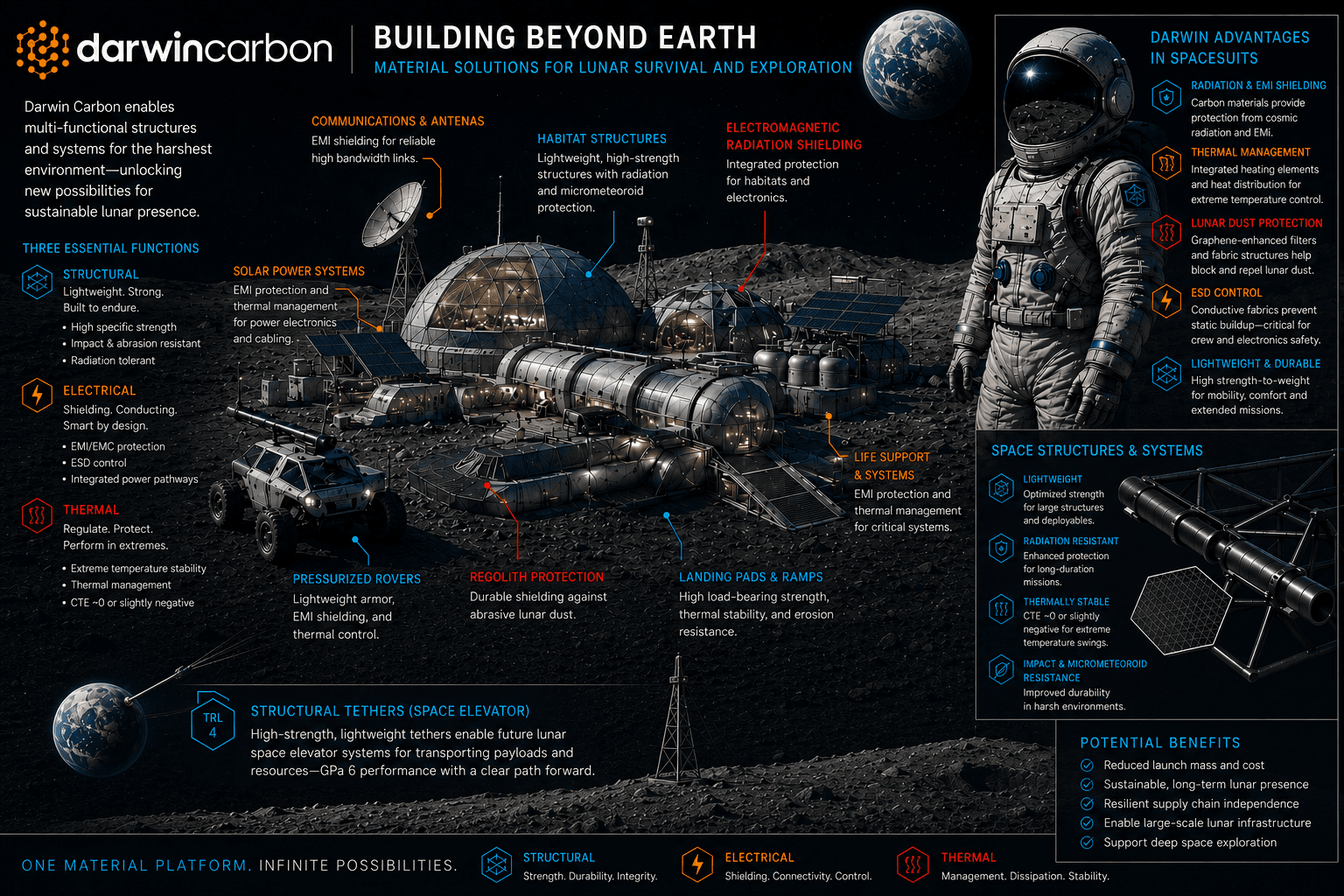
On the lunar surface, the same three functions — structural, electrical, thermal — combine in a single lightweight material across many systems. The illustration below maps where multifunctional carbon material may perform useful roles.
Potential application areas
- Habitat EMI shielding
- Thermal surfaces
- Resistive heating
- Cable / interconnect material concepts
- Equipment protection
- Lightweight structural / composite reinforcement
- Deployable systems
- Dust / extreme-temperature systems where supportable
Planned — NASA BAA submission
Darwin is preparing a planned year-end 2026 NASA BAA submission focused on material applications for future lunar infrastructure. No NASA funding has been awarded, no selection has been made, and no proposal has yet been submitted.
Thermal function · heating & de-icing
A material that can also be the heater.
Darwin’s electrical conductivity lets thin material forms function as resistive heating elements. The proof of that capability is terrestrial aerospace activity — the significance for space is the ability to integrate lightweight resistive heating into surfaces and structures where thermal control, freeze protection or equipment conditioning may matter.
Proven / tested heating capability
UAV de-icing
DevelopmentDarwin is engaged in de-icing / heating activities relevant to UAV systems.
Bell (rotorcraft de-icing)
DevelopmentDe-icing / heating development activity relevant to rotorcraft leading-edge surfaces.
The space opportunity is not "de-icing satellites." It is integrating lightweight resistive heating where thermal control, freeze protection or localized heating matters.
Configuration-dependent. Not a guaranteed or typical design property.
Micrometeoroid / impact protection
Ultralight protection for high-energy environments
Darwin materials are being explored and developed for ballistic and protective applications. The combination of low areal density, high tensile performance and energy-management potential creates an interesting pathway for evaluation in micrometeoroid and debris protection systems.
Concept · multilayer protective architecture
Conventional spacecraft standoff layer
Low-areal-density Darwin material concept for energy management
Primary structure
Directional impact →. Illustrative only; layer order and materials vary by system.
Darwin material has not been validated against micrometeorites and holds no MMOD qualification. The concept below shows how the material might participate in a multilayer protective architecture — not a standalone shield.
Representative CNT yarn value — not a general design criterion.
Satellite application map
Where the platform meets the spacecraft
Across a single satellite, one material family may perform several roles. Each carries an honest status — from active evaluation to application concept.
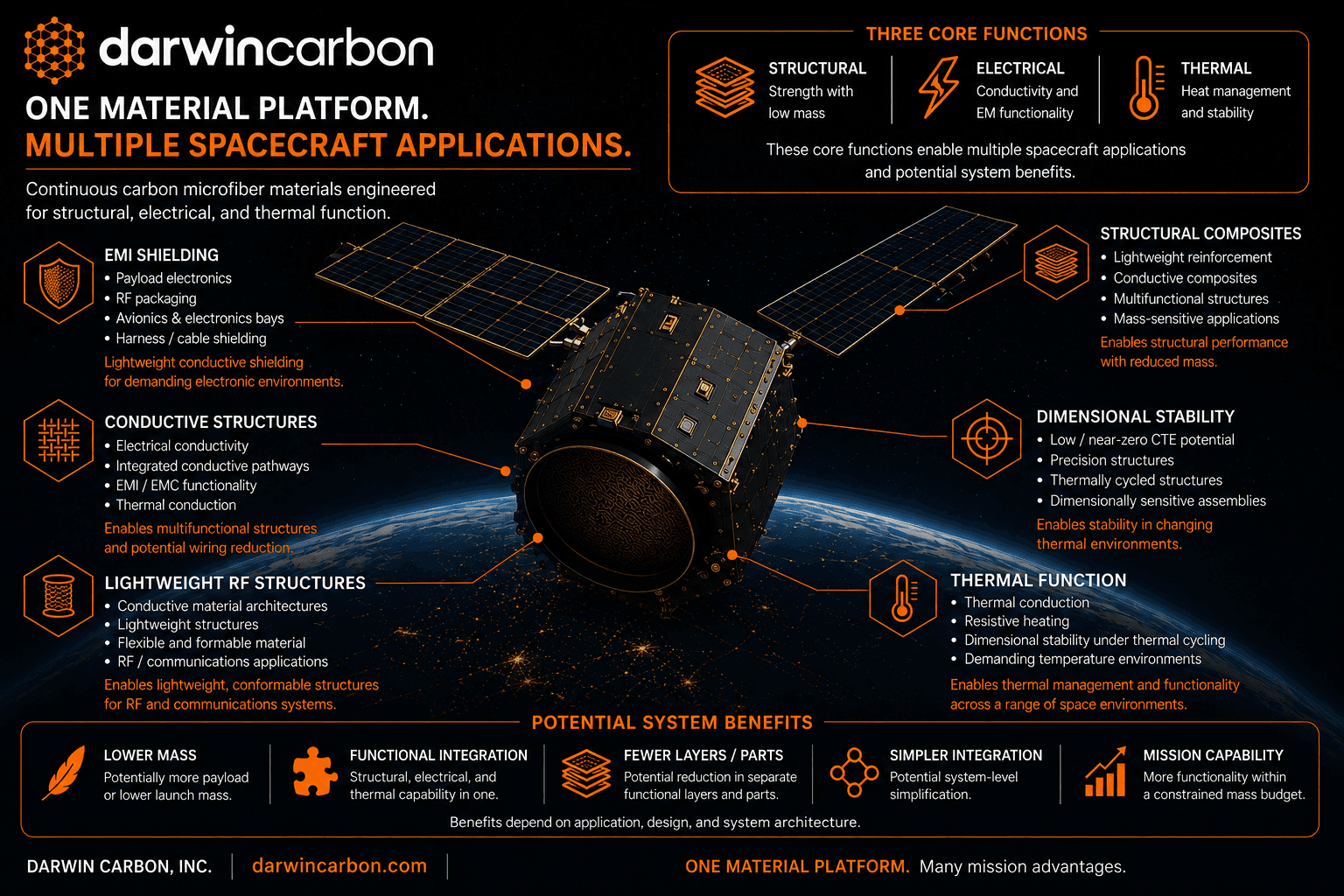
EMI shielding
Active EvaluationUltra-lightweight conductive sheet around sensitive electronics.
From Earth to orbit to the Moon
One platform, across every gram-critical environment.
Darwin isn’t developing a material exclusively for space. We’re developing a multifunctional material platform for environments in which mass, electrical performance, thermal performance and structural efficiency matter simultaneously. Space simply makes those tradeoffs unusually consequential.
Engagement
What could one less layer change?
Darwin works with aerospace and space-system developers to evaluate where continuous carbon microfiber materials can reduce mass, consolidate functions or enable architectures difficult to achieve with conventional materials.
Ways to engage
- Material evaluation
- Prototype development
- EMI testing
- Heater / de-icing development
- Composite integration
- Space-environment evaluation
- Jointly funded R&D
- Government programs